|
Road work planned in July for Kemmerer wildlife overpass installation (posted 7/3/2026)
40-minute road delays July 7-11, alternate routes recommended for travelers
Wyoming Department of Transportation
Public Notice to Kemmerer area travelers:
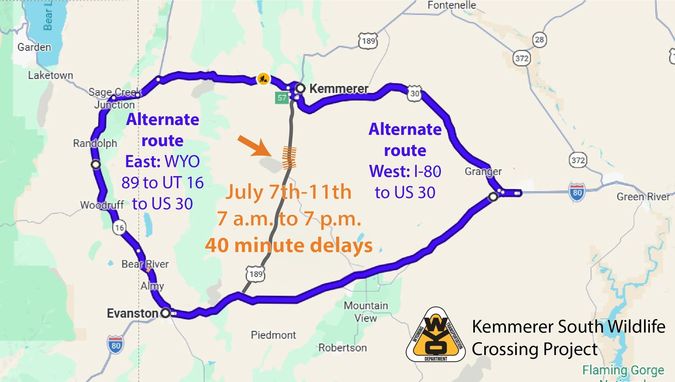
Beginning Tuesday, July 7, 2026, drivers on US 189 will see up to 40-minute delays as Wyoming Department of Transportation (WYDOT) and contract crews set sections of concrete arch for the wildlife overpass at mile marker 24.5 between Kemmerer and Evanston, Wyoming.
The work will take place from 7 a.m. to 7 p.m. for an estimated five days, July 7-11. Drivers are advised to seek alternate routes to their destinations, such as WY 89 to US 30 through the Utah border, or I-80 to US 30 via Granger.
"This can be dangerous work, with a large crane moving massive concrete sections. It’s the type of work that would be difficult to do at night safely, so for the safety of crews and the traveling public, we are doing the work during the day. Unfortunately, that means there will be times of extensive stop delay," WYDOT resident engineer Jennifer Hoffman said.
Kinky Creek Fire Update for July 3, 2026 (posted 7/3/2026)
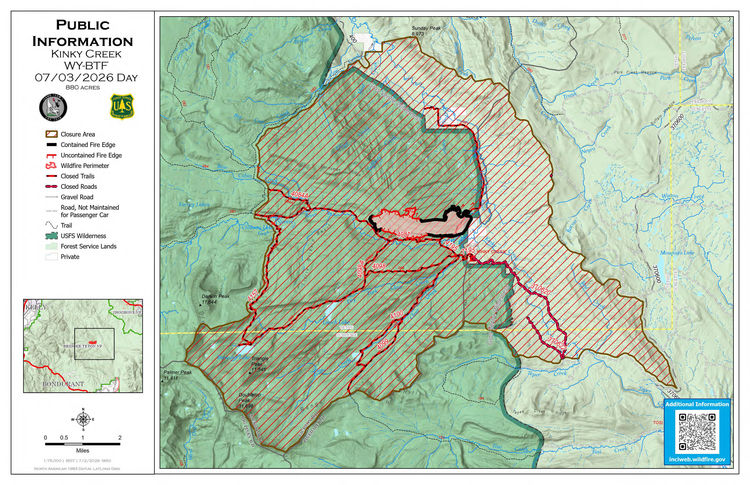
Lightning Caused, 880 Acres, 56% Contained, SET status lifted for Darwin Ranch area
Bridger-Teton National Forest
Firefighters continue to make significant progress on the Kinky Creek Fire, increasing containment to 56% through the continued hard work and dedication of crews assigned to the incident. Suppression efforts over the past several operational periods have strengthened containment lines and secured additional portions of the fire perimeter.
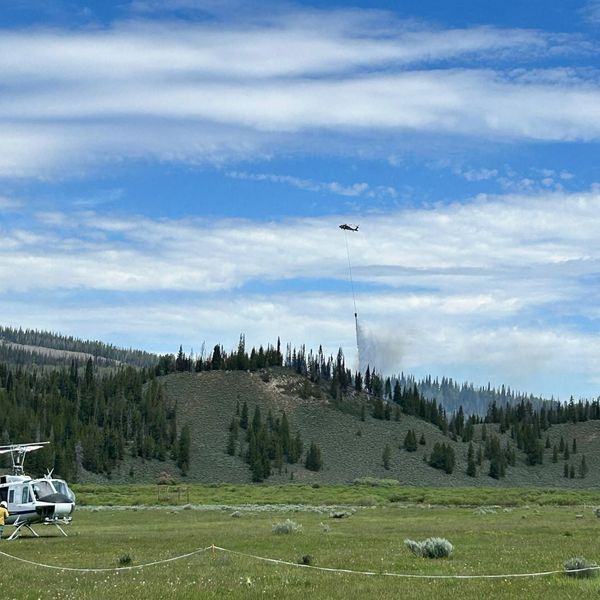
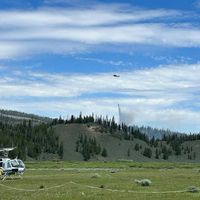
Ground crews remain focused on improving and reinforcing containment features while identifying and addressing areas of residual heat near the fire's edge. Aviation resources continue to support operations as needed, assisting firefighters working in steep, rugged terrain where access remains challenging.
The incident organization has begun right-sizing to match the current needs of the fire. As containment increases and suppression objectives are achieved, excess resources are being released to support other incidents across the region. Personnel assigned to the fire have been reduced to 114.
Safety remains the highest priority. Firefighters continue to work in challenging conditions that include steep slopes, hazardous fire-weakened trees, and changing weather patterns. Through diligent risk management and adherence to safety protocols, crews continue making progress while minimizing exposure to hazards.
Weather conditions remain a factor in daily operations. Thunderstorm activity and associated outflow winds may continue to challenge firefighting efforts, requiring firefighters to remain alert to rapidly changing conditions. Fire operations will continue to monitor forecasts and adjust tactics as necessary to maintain firefighter safety and operational effectiveness.
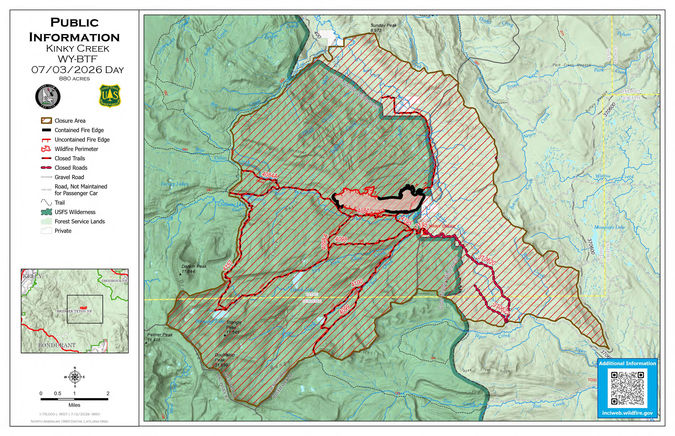
A closure order remains in effect for portions of the fire area. The public is asked to avoid Kinky Creek Road; Kinky Creek and Clear Creek trails; and the Brewster, Lunch, and Chateau Lake areas so firefighters can work safely and efficiently.
As containment increases and fire activity decreases, local emergency managers have reduced precautionary measures for nearby residents. Teton County Emergency Management has lifted the SET status for Darwin Ranch and surrounding private lands due to the reduced threat posed by the fire. Residents and visitors are encouraged to remain aware of current conditions and continue monitoring official sources for incident information.
The Kinky Creek Fire is located west of Darwin Ranch, near Upper Gros Ventre Falls in the Gros Ventre Wilderness on the Jackson Ranger District of the Bridger-Teton National Forest. The fire is burning in heavy timber on steep, rugged terrain.
Governor seeks public comment on proposed Sage Grouse Executive Order Revisions (posted 7/3/2026)
Governor Gordon media release
Governor Mark Gordon (R-WY) is seeking public comment on proposed revisions to the Sage Grouse Executive Order. These changes stem from updates to the Governor’s Executive Order 2019-3 Greater Sage Grouse Core Area Protection.
https://drive.google.com/file/d/1MO0i6GaNWmg52tUJm5SoezpbyhLjc6Jp/view
"Wyoming has consistently advocated for a Greater sage-grouse strategy that recognizes the State’s management authority over the species utilizing the best-available science," Governor Gordon said. "Wyoming remains a leader in the sage-grouse conservation, and the State of Wyoming’s Executive Order Greater Sage-Grouse Core Area Protection has proven to be a successful strategy that has spanned three Governors in its foresight to have a state-lead conservation strategy. We appreciate the public’s input as we continue to invest in sage-grouse conservation alongside responsible development in Wyoming."
Written comments will be accepted through 5 p.m. July 30.
https://docs.google.com/forms/d/1puuShF4o6yTsheya2PxV4Y4a8LVKDtTWZuro3lLLM5s/edit?ts=6a19b3c8
Road maintenance on Granite Creek Road (posted 7/1/2026)
Short closure on Monday, July 13th for surface treatment
Bridger-Teton National Forest
The Bridger-Teton National Forest will begin road maintenance work on the Granite Creek Road beginning the week of July 1, with work anticipated to be completed by July 14.
The project aims to provide a safer transportation system and protect existing infrastructure. This will be accomplished by improving the driving surface through surface blading, cleaning ditches and culverts and adding new surface course material—a fresh layer of crushed gravel that restores and improves the road surface. The Bridger-Teton Roads Crew will apply a magnesium chloride product to the road surface, which will help to reduce dust and protect loss of aggregate in the surface course material.
Motorists can expect numerous large haul trucks and other heavy equipment operating on Granite Creek Road (NFSR 30500) from approximately milepost 0.0 to milepost 7.5. The Forest will conduct general road maintenance through July 14, with aggregate deliveries beginning July 6. The road will close to traffic from 9 a.m. to approximately 3 p.m. on July 13, to allow for a magnesium chloride application.
The product used for dust abatement is a slurry of magnesium chloride, the same product that is used to treat dirt roads throughout Wyoming. This product coats the road surface, but it can also adhere to the undercarriage of vehicles before it fully cures. Motorists who drive the treated portion of Granite Creek Road after it reopens may want to rinse off their vehicles to eliminate any residue.
The public should use extra caution when driving in the area. When passing heavy equipment, ensure operators can see your vehicle before proceeding and allow extra space around construction traffic. The public can expect intermittent traffic delays and should follow all posted signage and traffic restrictions in the area.
The Bridger-Teton National Forest appreciates the public’s cooperation and understanding. These temporary disruptions will result in improved road conditions and better recreational access.
The Granite Creek Road Maintenance Project is in partnership with The Hawken Ranch. The Bridger-Teton Roads Crew is providing maintenance, grading and gravel spreading, and The Hawken Ranch is contributing with material acquisition and supply, including aggregate gravel and magnesium chloride.
Roadwork schedules may change, or be delayed, due to weather conditions, equipment malfunction, or other extenuating circumstances.
Courtesy photo
|
Kinky Creek Fire 12% contained, 880 acres (posted 6/30/2026)
Update for June 30, 2026
Bridger-Teton National Forest
The lightning-caused Kinky Creek Fire is currently estimated at 880 acres and is 12% contained. Approximately 134 personnel are assigned to the incident.
The Kinky Creek Fire is located west of Darwin Ranch, near Upper Gros Ventre Falls in the Gros Ventre Wilderness on the Jackson Ranger District of the Bridger-Teton National Forest. The fire is burning in heavy timber on steep, rugged terrain.
Fire crews disengaged from the fire on Saturday due to hazardous conditions and incoming inclement weather, returned to operations today. Firefighters are beginning mop-up operations and conducting structure assessments in the southeastern portion of the fire area nearest Darwin Ranch. These efforts will help identify and address any remaining heat near containment lines while ensuring structures and improvements remain protected.
Firefighters are also working to connect existing containment lines with natural barriers around the fire perimeter. Utilizing natural features such as rocky terrain, sparse fuels, and other landscape characteristics can strengthen containment efforts while minimizing impacts to the surrounding wilderness.
On the northern portion of the fire, crews continue scouting for opportunities to safely and effectively engage the fire's edge. Steep slopes, limited access, and heavy timber continue to present challenges, but firefighters are evaluating locations where direct suppression actions may be implemented.
Several days of cool, wet weather, including rain and snow at higher elevations, have moderated fire behavior and provided firefighters opportunities to make progress on suppression objectives. However, the precipitation has not extinguished the fire. Unburned and partially burned fuels remain receptive within the fire perimeter, and heat continues to persist in heavy timber and deep organic material. Accessing and extinguishing these heat sources can be hazardous due to steep terrain, unstable footing, and the potential for falling trees and rolling material. Fire managers will continue to track interior heat and address hotspots as conditions allow.
Aircraft assigned to the Kinky Creek Fire are expected to conduct scooper operations on Jackson Lake today in support of suppression efforts. Boaters, paddlers, anglers, and other recreationists are asked to remain alert for low-flying aircraft and stay well clear of scoopers as they collect water throughout the day. Maintaining a safe distance from aircraft helps prevent operational delays and allows firefighters on the ground to receive the aerial support needed to safely and effectively carry out suppression activities. Public cooperation helps ensure aviation resources can operate safely and efficiently in support of the incident.
The public is asked to avoid Kinky Creek Road; Kinky Creek and Clear Creek trails; and the Brewster, Lunch, and Chateau Lake areas so firefighters can work safely and efficiently. A closure order remains in effect for portions of the fire area.
Teton County Emergency Management continues to advise that Darwin Ranch and nearby private lands remain in SET status due to the Kinky Creek Fire. Residents and visitors should review evacuation plans, gather essential items, and remain prepared should protective actions become necessary.
Resources assigned to the fire include helicopters, water scoopers, hand crews, engines, overhead personnel, and support staff.
Email: 2026.kinkycreek@firenet.gov
Fire Information Phone: 307-295-2770
Email: 2026.kinkycreek@firenet.gov
Fire Information Phone: 307-295-2770
|
Wyoming Air National Guard to fly statewide salute across Wyoming on July 4 (posted 6/30/2026)
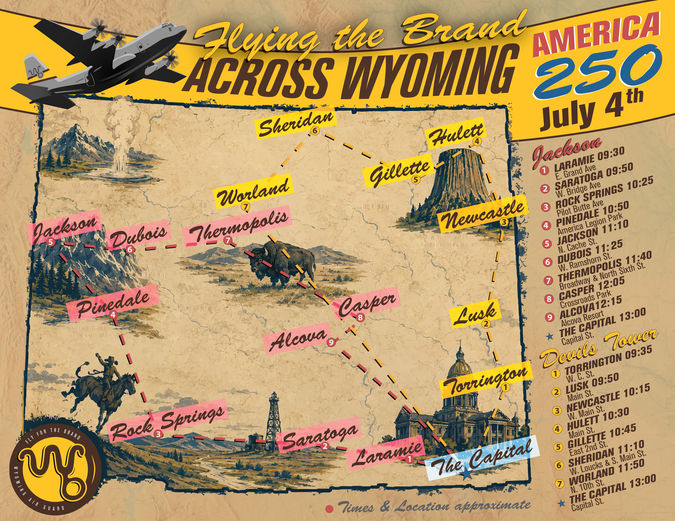
Over Pinedale around 10:50AM
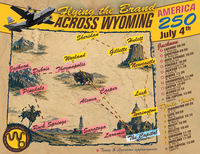
The 153rd Airlift Wing, Wyoming Air National Guard, will conduct a statewide flyover Saturday as part of America 250, the nationwide commemoration of the United States' 250th anniversary of independence.
The mission, dubbed "Flying the Brand Across Wyoming," will send Guard aircraft along two simultaneous routes — the Jackson Route and the Devils Tower Route — reaching more than a dozen communities from the eastern plains to the mountains of western Wyoming.
The 153rd Airlift Wing, based at Cheyenne’s Wyoming Air National Guard Base, operates the C-130 Hercules and is the state’s primary airlift asset. Both routes conclude at the state Capitol in Cheyenne at 1 p.m.
"We are proud to mark this milestone by flying over communities across Wyoming on Independence Day," said Col. Brian Diehl, commander, 153rd Airlift Wing, Wyoming Air National Guard. "It is a great opportunity for our wing to connect with the people we serve and celebrate 250 years of American independence together."
Jackson Route
The Jackson Route departs Cheyenne and travels west then north. All times are approximate:
Laramie, E. Grand Ave., 9:30 a.m.
Saratoga, W. Bridge Ave., 9:50 a.m.
Rock Springs, Pilot Butte Ave., 10:25 a.m.
Pinedale, American Legion Park, 10:50 a.m.
Jackson, N. Cache St., 11:10 a.m.
Dubois, W. Ramshorn St., 11:25 a.m.
Thermopolis, Broadway and N. Sixth St., 11:40 a.m.
Casper, Crossroads Park, 12:05 p.m.
Alcova, Alcova Resort, 12:15 p.m.
Cheyenne (state Capitol), Capitol St., 1 p.m.
Devils Tower Route:
The Devils Tower Route departs Cheyenne and travels north through northeastern Wyoming. All times are approximate:
Torrington, W.C. St., 9:35 a.m.
Lusk, Main St., 9:50 a.m.
Newcastle, W. Main St., 10:15 a.m.
Hulett, Main St., 10:30 a.m.
Gillette, E. Second St., 10:45 a.m.
Sheridan, W. Loucks and S. Main St., 11:10 a.m.
Worland, N. 10th St., 11:50 a.m.
Cheyenne (state Capitol), Capitol St., 1 p.m.
Residents are encouraged to gather at or near the listed locations to view the aircraft. No tickets or registration are required.
All times and locations are approximate and subject to change based on weather and operational requirements. Flight routes have been coordinated with the Federal Aviation Administration and are fixed. The 153rd Airlift Wing is unable to accommodate requests for additional flyover locations.
About the 153rd Airlift Wing, Wyoming Air National Guard
The 153rd Airlift Wing, headquartered in Cheyenne, is Wyoming's only Air National Guard flying unit. Operating the C-130 Hercules, the wing provides airlift for troops and cargo, delivers humanitarian aid worldwide, and is one of only four units in the nation equipped with the Modular Airborne Fire Fighting System (MAFFS) for wildfire suppression. At home, the wing responds to state emergencies and natural disasters at the request of the Governor of Wyoming. The wing's Airmen combine global reach with local impact, representing Wyoming and the nation wherever they serve.

|
Price of Forever stamp going up on July 12 (posted 6/30/2026)
From $.78 to $.82 cents
The U.S. Postal Service (USPS) will be increasing the cost of a First-Class mail Forever Stamp by 4 cents, to $.82 cents, on Sunday, July 12, 2026. Some other postage rates will also be increasing. This is a 4.8% average price increase on mailing services.
Key changes include:
Forever Stamps: Increasing from $0.78 to $0.82
Metered Letters (1 oz): Increasing from $0.74 to $0.78
Domestic Postcards: Increasing from $0.61 to $0.65
International Letters/Postcards: Increasing from $1.70 to $1.75
The USPS adjusts postage rates at least once a year, and sometimes more frequently. Rate changes are in response to factors such as fuel cost fluctuations, inflation, and operational enhancements, as well as a continuing decline in mail volume.
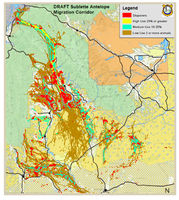
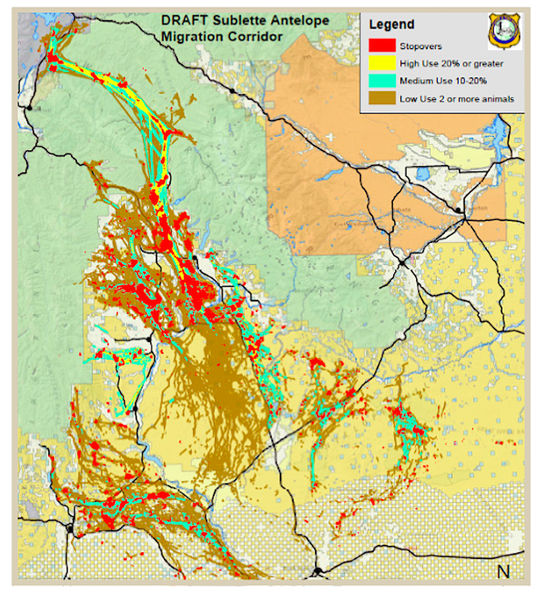
Map provided to the local working group. Each of the segments will have its own map with specific details and Game and Fish teams will work on their respective issues. The designation does not affect private land / property rights or grazing on public lands.
|
Governor designates Sublette Pronghorn Migration Corridor (posted 6/28/2026)
Joy Ufford
In January, 2026, Wyoming Gov. Mark Gordon called for creation of the Sublette Antelope Migration Corridor Local Working Group – 11 stakeholders with a broad range of interests from Sublette, Lincoln, Teton and Sweetwater counties – to consider its official designation.
Six short months later, after five intense public meetings with Wyoming Game and Fish in Rock Springs and Pinedale, coordinated by the Governor’s Office, the local working group (LWG) submitted its final report recommending the official designation.
Gov. Gordon had promised a quick turnaround on the LWG’s report on the near-historic pace of progress and on Friday, June 26, at a special presentation held at Trappers Point monument in Pinedale, he announced the designation was official. Wyoming Game and Fish Director Angi Bruce spoke next, followed by WGF Commissioner Ken Roberts and LWG Chair Robb Slaughter.
The working group and its materials were labeled "Sublette Antelope Working Group." Many people at the event said they always called the speedy animal "antelope" but the correct name is pronghorn.
The governor stated Friday, "Pronghorn. We aren’t going to call them antelope here today."
Executive Order 2021-01
On Jan. 20, 2026, Gov. Gordon tasked the Sublette (Antelope) Pronghorn LWG with "historic work" of analyzing Wyoming Game and Fish findings through his Migration Corridor Conservation Strategy, Executive Order 2020-01 – a "state-led approach to support conservation for mule deer and pronghorn migration while preserving multiple use opportunities for the State of Wyoming." The multi-county group of stakeholders would "hone in on the local issues specific to the Sublette Pronghorn Migration Corridor," he said.
The eight segments from south to north are Calpet, Fontenelle, Southwest, Central, East of Wyoming-191, Foothills, Bondurant and North, stretching almost 150 miles through desert, river bottoms, plateaus, mountains, hillsides – and towns, subdivisions, energy and mining projects.
The Executive Order does not apply to private land, but private landowners and developers could be crucial to maintaining the migration corridor – facts that LWG members appeared to keep uppermost in mind.
Stakeholders
The LWG members are Chair Sweetwater County Commissioner Robb Slaughter, Sublette County Commissioner Lynn Bernard, Teton County Commissioner Mark Newcomb, Lincoln County Commissioner Kent Connelly, agriculture representatives Sublette County Conservation District Manager Michael Henn and John Erramouspe, mining/industry representatives Jasmine Allison and Craig Rood, motorized recreation’s Dave Lankford and wildlife/hunting/conservation members Mike Brennan and Maggie Hudlow.
"I am not asking you to solve every problem and analyze every inch of every corridor, but to make improvements to the strategy for the Sublette Antelope Migration Corridor as best you can," Gov. Gordon wrote them on Jan. 20. "Your charge is not to work for months upon months but to get the job done this spring and pass along your recommendations for me to consider. I will also ask you, at the end of your process, to give me feedback on needed refinements or clarifications within the Wyoming Mule Deer and Antelope Migration Corridor Executive Order."
Governor’s Office’s Sara DiRienzo planned and facilitated five LWG public meetings, one in Rock Springs and four Pinedale, where the first two and last two meetings took place. She updated the consensus-based draft recommendations, with LWG members receiving in-depth information from WGFD migration and wildlife experts, state agencies, county planners and other administrators. The LWG would then work between meetings to fine-tune the draft and to prepare for the next meeting. The interested public also participated extensively during public comment periods and on the WGFD website.
The group’s overall final recommendation of support to officially designate the migration corridor’s eight segments, was unanimous at its May 29, 2026 meeting in Sublette County – with two members having "minor" reservations and one with "major reservations, but would not object."
Reaching consensus
The LWG consensus decision voting on specific proposed recommendations used the "four-point scale" of fingers.
One finger meant "Endorsement – member likes and supports it."
Two meant "Agreement with minor reservations – member can live with it."
Three – "Major reservations – formal disagreement but will not object to the proposal/ provision.
Four – "Member will not support the proposal."
If a LWG member was undecided, he or she would state what information they needed and the group would vote again. Consensus meant that all members voted 1 or 2. Voting 3 or 4 meant consensus with reservations, calling for discussions, but moving forward after three votes if the majority agreed. The purpose was to ensure one stakeholder could not derail the entire process.
Priorities
The Governor’s four priorities to determine if the migration corridor needed state designation:
• Review the Wyoming Game and Fish Department’s Biological Risk Assessment: Accurately review and identify risks, conservation opportunities.
• Review the Corridor components: Bottlenecks, stopover areas, protection buffers and future research.
• Review of the impacts of all restrictions on development and use of lands encompassed in the proposed designation corridor (county plans, BLM and Forest Service plans): Consider socioeconomic impacts, jobs, proposed projects and if protections are sufficient to address threats.
• Review planned WYDOT highway projects for wildlife crossing opportunities and priority.
WGFD had requested official designation of the its Sublette Pronghorn Migration Corridor’s 10 identified segments but the Governor removed two sections of the Red Desert and Farson as requested by landowners and stock growers. Bringing them back on the table was not an option, according to the Governor, although some members thought they belonged in the "identified" corridor. LWG members reported comments made to them to expand or alter parts of corridor segments. The group determined early that it would consider all eight segments as a whole.
Final report
In its final report, submitted May 30, 2026 to Gov. Gordon, the LWG included specific conclusions on the importance of working with landowners and agencies to fund, modify or remove certain fences; to support dedicated funding for conservation easements or special leases of open land; invest in habitat improvements including cheatgrass treatment and water infrastructure; to continue to uphold private property rights and access to mineral rights and resolving potential conflicts with the least impact to pronghorn and to hold BLM accountable for managing wild horses and total removal outside of active herd units.
Other recommendations are to use local WGFD expertise and identify significant barriers, strategies to develop a post-designation monitoring strategy and ensure adequate forage is available during hard times. Buffers that were marked in error should be corrected. The group also called for WGFD to impose its authority over wildlife in the migration corridor with proposed development and with federal land managers.
It advised "a Memorandum of Understanding (MOU) among the Wyoming Game and Fish Department, Bureau of Land Management Wyoming and regional US Forest Service to consolidate resources and coordinate conservation efforts within the antelope migration corridor."
WGFD should continue and collaborate for public education and promoting the Sublette Antelope/Pronghorn Migration Corridor and the value of Wyoming’s wildlife resources. As a valuable partner, WYDOT can pursue additional wildlife crossings and use dynamic messaging to alert travelers of migration movements.
The four counties and conservation districts could coordinate residential, industry and recreation development policies, with regard to bottlenecks and impacts to economic development. "Thoughtful planning underscores these values," it says.
In closing
"The SALWG finds that existing protections are valuable and impactful but are not by themselves sufficient to ensure long-term functionality of the Sublette Antelope Migration Corridor for future generations," the report concludes.
"Though there was majority support, it is noted the SALWG did not reach unanimous consensus on the recommendation to designate. Some members expressed concerns about overlapping protections, federal interpretation, shortened timing windows for projects to be conducted on the ground and potential to adversely affect the implementation of future reclamation practices, including considerations for counties and other land-management localities."
"This MOU could include, but is not limited to, asserting state-led management of wildlife and existing plans, directing resources for habitat, rangeland, and water improvement; fencing modifications; reaffirming valid existing rights; reinforcing the right and ability to graze livestock on federal and state lands; and addressing other conservation concerns within the corridor."
For more
The Sublette Migration Corridor Local Working Group’s meeting agendas, minutes, recordings and final report are available at wgfd.wyo.gov. Go through Wyoming Wildlife, Migration Corridor Conservation Strategy to Sublette Antelope https://sites.google.com/view/

|
SUN Bucks summer food program launches in Wyoming (posted 6/23/2026)
Wyoming Department of Family Services
The Wyoming Department of Family Services (DFS) is officially launching the SUN Bucks program, announcing important dates and a help line for Wyoming families.
Sun Bucks is a federal program to support eligible school-aged children by providing grocery money for the summer months. Governor Mark Gordon directed DFS to implement the program in Wyoming with an executive order on April 15.
"This is an essential program to give a little boost for children in our state who may not otherwise have access to healthy food. We want our children to thrive, because when our children are successful, so too are our communities." Governor Mark Gordon said.
More than 37,000 qualified children will be automatically enrolled in SUN Bucks for summer 2026 without needing to apply (already in SNAP and POWER programs). Families will begin receiving notifications this week that their children qualified for SUN Bucks in an email message from sunbucks@dfs.wyo.gov, or in the mail. SUN Bucks electronic benefit transfer cards will be mailed to eligible children beginning in early July.
"We are grateful to the governor for supporting this program, and we are excited to implement it," said DFS Director Korin Schmidt. "SUN Bucks helps feed our rural children who are out of school for the summer and are missing school breakfast and school lunch. This allows families to buy groceries when they are able so they can have food in the house for those missed meals."
Families will receive one SUN Bucks card for each eligible child, which will be pre-loaded with a $120 food benefit. The SUN Bucks card can be used at any participating Supplemental Nutrition Assistance Program (SNAP) retailer.
Some children may be eligible but not enrolled in SUN Bucks. Families can check their child’s enrollment status and apply online at https://sunbucks.dfs.wyo.gov/ starting Monday, June 22.
For more information visit the DFS website at dfs.wyo.gov, email ask-sunbucks@wyo.gov, or call the SUN Bucks Customer Service Line between 8:15 a.m. to 4:45 p.m. Monday through Friday at 307-777-8SUN (307-777-8786).
Fire danger raised to HIGH (posted 6/19/2026)
Bridger-Teton National Forest
Teton Interagency Fire managers have elevated the fire danger rating to "high" for Grand Teton National Park, the Bridger-Teton National Forest, and the National Elk Refuge.
While the landscape may still appear green, heavy dead and down timber and fuels are what drive fire activity. A high fire danger means wildfires can start easily and spread quickly. Fire managers consider things like fuel moisture (how dry grasses, shrubs, and trees are), forecasted temperatures and wind, how fast fires can grow, and whether firefighting resources are available nationwide.
What You Can Do
The safest option is to not build a fire at all. Dress warmly and use layers instead of relying on campfires for warmth.
If you choose to have a fire in areas where it's allowed:
• Never leave a campfire unattended.
• Have a shovel and water bucket on hand.
• Use several gallons of water to fully extinguish your campfire.
• Drown, stir, feel and repeat until the ashes are cold to the touch.
• Break up charred logs and cover all remains with dirt.
So far this year, 38 unattended campfires have been found in the Teton Interagency Fire area. If your fire sparks a wildfire, you can be held responsible for the cost of putting it out.
Fireworks Are Always Prohibited
As we approach the Independence Day holiday, a reminder: fireworks are strictly prohibited in Grand Teton National Park, the Bridger-Teton National Forest, and the National Elk Refuge. These regulations are essential to preventing wildfires during a time of heightened risk.
For the latest fire updates, safety tips, and current restrictions, visit TetonFires.com.
To report smoke or a fire, call the Teton Interagency Fire Dispatch Center at 307-739-3630.
|
Business
Directory
|