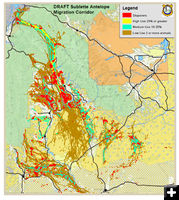
Draft Pronghorn Migration Map
Map provided to the local
working group. Each of the
segments will have its own
map with specific details
and Game and Fish teams
will work on their
respective issues.
The designation does not
affect private land /
property rights or grazing
on public lands.
|
|
Governor designates Sublette Pronghorn Migration Corridor
by Joy Ufford
June 28, 2026
In January, 2026, Wyoming Gov. Mark Gordon called for creation of the Sublette Antelope Migration Corridor Local Working Group – 11 stakeholders with a broad range of interests from Sublette, Lincoln, Teton and Sweetwater counties – to consider its official designation.
Six short months later, after five intense public meetings with Wyoming Game and Fish in Rock Springs and Pinedale, coordinated by the Governor’s Office, the local working group (LWG) submitted its final report recommending the official designation.
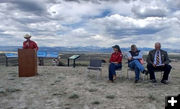
Gov. Gordon had promised a quick turnaround on the LWG’s report on the near-historic pace of progress and on Friday, June 26, at a special presentation held at Trappers Point monument in Pinedale, he announced the designation was official. Wyoming Game and Fish Director Angi Bruce spoke next, followed by WGF Commissioner Ken Roberts and LWG Chair Robb Slaughter.
The working group and its materials were labeled "Sublette Antelope Working Group." Many people at the event said they always called the speedy animal "antelope" but the correct name is pronghorn.
The governor stated Friday, "Pronghorn. We aren’t going to call them antelope here today."
Executive Order 2021-01On Jan. 20, 2026, Gov. Gordon tasked the Sublette (Antelope) Pronghorn LWG with "historic work" of analyzing Wyoming Game and Fish findings through his Migration Corridor Conservation Strategy, Executive Order 2020-01 – a "state-led approach to support conservation for mule deer and pronghorn migration while preserving multiple use opportunities for the State of Wyoming." The multi-county group of stakeholders would "hone in on the local issues specific to the Sublette Pronghorn Migration Corridor," he said.
The eight segments from south to north are Calpet, Fontenelle, Southwest, Central, East of Wyoming-191, Foothills, Bondurant and North, stretching almost 150 miles through desert, river bottoms, plateaus, mountains, hillsides – and towns, subdivisions, energy and mining projects.
The Executive Order does not apply to private land, but private landowners and developers could be crucial to maintaining the migration corridor – facts that LWG members appeared to keep uppermost in mind.
Stakeholders
The LWG members are Chair Sweetwater County Commissioner Robb Slaughter, Sublette County Commissioner Lynn Bernard, Teton County Commissioner Mark Newcomb, Lincoln County Commissioner Kent Connelly, agriculture representatives Sublette County Conservation District Manager Michael Henn and John Erramouspe, mining/industry representatives Jasmine Allison and Craig Rood, motorized recreation’s Dave Lankford and wildlife/hunting/conservation members Mike Brennan and Maggie Hudlow.
"I am not asking you to solve every problem and analyze every inch of every corridor, but to make improvements to the strategy for the Sublette Antelope Migration Corridor as best you can," Gov. Gordon wrote them on Jan. 20. "Your charge is not to work for months upon months but to get the job done this spring and pass along your recommendations for me to consider. I will also ask you, at the end of your process, to give me feedback on needed refinements or clarifications within the Wyoming Mule Deer and Antelope Migration Corridor Executive Order."
Governor’s Office’s Sara DiRienzo planned and facilitated five LWG public meetings, one in Rock Springs and four Pinedale, where the first two and last two meetings took place. She updated the consensus-based draft recommendations, with LWG members receiving in-depth information from WGFD migration and wildlife experts, state agencies, county planners and other administrators. The LWG would then work between meetings to fine-tune the draft and to prepare for the next meeting. The interested public also participated extensively during public comment periods and on the WGFD website.
The group’s overall final recommendation of support to officially designate the migration corridor’s eight segments, was unanimous at its May 29, 2026 meeting in Sublette County – with two members having "minor" reservations and one with "major reservations, but would not object."
Reaching consensus
The LWG consensus decision voting on specific proposed recommendations used the "four-point scale" of fingers. One finger meant "Endorsement – member likes and supports it."
Two meant "Agreement with minor reservations – member can live with it."
Three – "Major reservations – formal disagreement but will not object to the proposal/ provision.
Four – "Member will not support the proposal."
If a LWG member was undecided, he or she would state what information they needed and the group would vote again. Consensus meant that all members voted 1 or 2. Voting 3 or 4 meant consensus with reservations, calling for discussions, but moving forward after three votes if the majority agreed. The purpose was to ensure one stakeholder could not derail the entire process.
Priorities
The Governor’s four priorities to determine if the migration corridor needed state designation:
• Review the Wyoming Game and Fish Department’s Biological Risk Assessment: Accurately review and identify risks, conservation opportunities.
• Review the Corridor components: Bottlenecks, stopover areas, protection buffers and future research.
• Review of the impacts of all restrictions on development and use of lands encompassed in the proposed designation corridor (county plans, BLM and Forest Service plans): Consider socioeconomic impacts, jobs, proposed projects and if protections are sufficient to address threats.
• Review planned WYDOT highway projects for wildlife crossing opportunities and priority.
WGFD had requested official designation of the its Sublette Pronghorn Migration Corridor’s 10 identified segments but the Governor removed two sections of the Red Desert and Farson as requested by landowners and stock growers. Bringing them back on the table was not an option, according to the Governor, although some members thought they belonged in the "identified" corridor. LWG members reported comments made to them to expand or alter parts of corridor segments. The group determined early that it would consider all eight segments as a whole.
Final report
In its final report, submitted May 30, 2026 to Gov. Gordon, the LWG included specific conclusions on the importance of working with landowners and agencies to fund, modify or remove certain fences; to support dedicated funding for conservation easements or special leases of open land; invest in habitat improvements including cheatgrass treatment and water infrastructure; to continue to uphold private property rights and access to mineral rights and resolving potential conflicts with the least impact to pronghorn and to hold BLM accountable for managing wild horses and total removal outside of active herd units.
Other recommendations are to use local WGFD expertise and identify significant barriers, strategies to develop a post-designation monitoring strategy and ensure adequate forage is available during hard times. Buffers that were marked in error should be corrected. The group also called for WGFD to impose its authority over wildlife in the migration corridor with proposed development and with federal land managers.
It advised "a Memorandum of Understanding (MOU) among the Wyoming Game and Fish Department, Bureau of Land Management Wyoming and regional US Forest Service to consolidate resources and coordinate conservation efforts within the antelope migration corridor."
WGFD should continue and collaborate for public education and promoting the Sublette Antelope/Pronghorn Migration Corridor and the value of Wyoming’s wildlife resources. As a valuable partner, WYDOT can pursue additional wildlife crossings and use dynamic messaging to alert travelers of migration movements.
The four counties and conservation districts could coordinate residential, industry and recreation development policies, with regard to bottlenecks and impacts to economic development. "Thoughtful planning underscores these values," it says.
In closing
"The SALWG finds that existing protections are valuable and impactful but are not by themselves sufficient to ensure long-term functionality of the Sublette Antelope Migration Corridor for future generations," the report concludes.
"Though there was majority support, it is noted the SALWG did not reach unanimous consensus on the recommendation to designate. Some members expressed concerns about overlapping protections, federal interpretation, shortened timing windows for projects to be conducted on the ground and potential to adversely affect the implementation of future reclamation practices, including considerations for counties and other land-management localities."
"This MOU could include, but is not limited to, asserting state-led management of wildlife and existing plans, directing resources for habitat, rangeland, and water improvement; fencing modifications; reaffirming valid existing rights; reinforcing the right and ability to graze livestock on federal and state lands; and addressing other conservation concerns within the corridor."
For more info
The Sublette Migration Corridor Local Working Group’s meeting agendas, minutes, recordings and final report are available at wgfd.wyo.gov. Go through Wyoming Wildlife, Migration Corridor Conservation Strategy to Sublette Antelope https://sites.google.com/view/
|